

PCR-Rich Glass Container Market Set to Double by 2035, Driven by Growth in Asia Pacific and Premium Packaging Segments
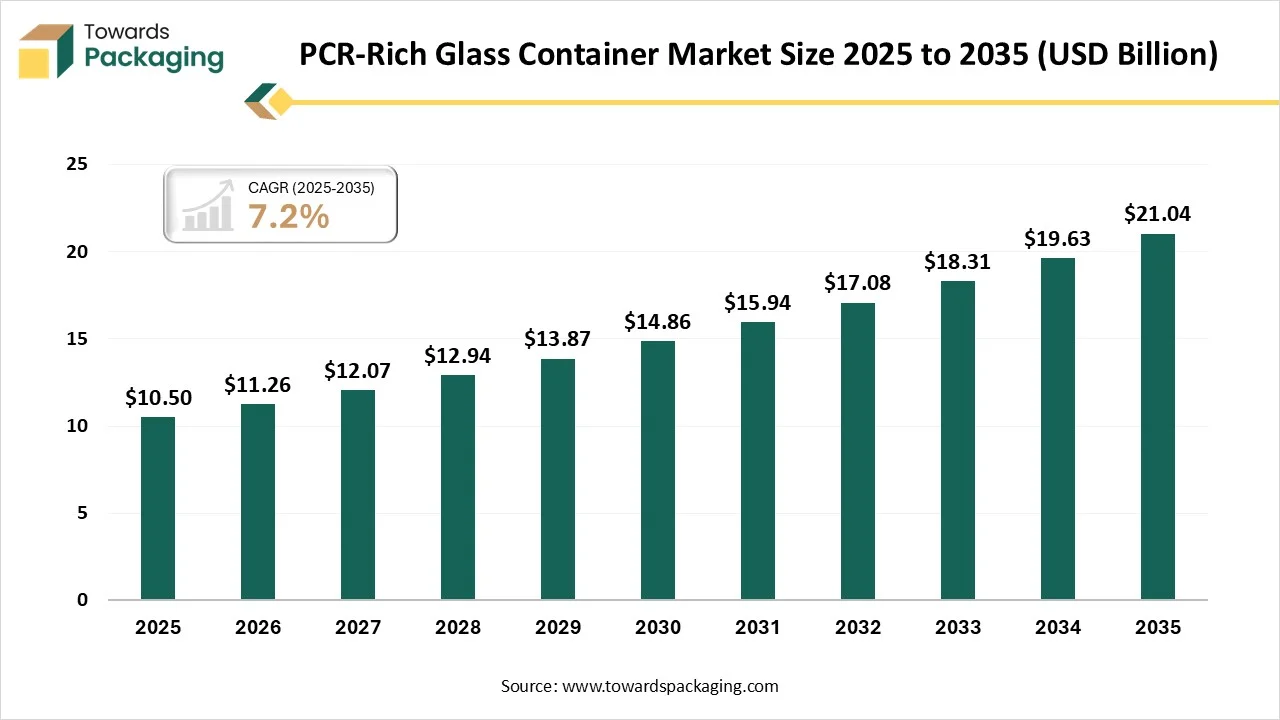
The global PCR-rich glass container market is projected to reach approximately USD 21.04 billion by 2035, increasing from USD 10.5 billion in 2025, at a CAGR of 7.2% during the forecast period 2026 to 2035, According to Towards Packaging consultants a sister firm of Precedence Research.
Ottawa, Feb. 27, 2026 (GLOBE NEWSWIRE) -- The global PCR-rich glass container market size stood at USD 10.5 billion in 2025 and is projected to reach USD 21.04 billion by 2035.
Request Research Report Built Around Your Goals: sales@towardspackaging.com
What is meant by the PCR-Rich Glass Container?
Post-consumer recycled (PCR)-rich glass containers are packaging solutions made with a high proportion of recycled glass collected after consumer use, reducing raw material demand and waste. The market is gaining strategic importance as brands and regulators emphasize sustainability, waste reduction, and circular economy goals. Enhanced recycling infrastructure, consumer preference for eco-friendly packaging, and corporate commitments to reduce carbon footprint are driving wider adoption of PCR-rich glass in food, beverage, and pharmaceutical sectors.
Private Industry Investments for PCR-Rich Glass Containers:
- Ardagh Glass Packaging & CAP Glass Partnership: This investment focuses on establishing recycling logistics across the U.S. to convert tens of thousands of tons of waste into high-quality cullet for new container production.
- Stoelzle Glass Group's Köflach Upgrade: A €22 million investment in their Köflach plant funded a state-of-the-art furnace specifically designed to integrate 20% PCR cullet into the batch.
- AGI Glaspac's Recycling Infrastructure: The company committed $18.5 million to acquire specialized glass recycling equipment and NNPB technology to boost the recycled content capacity of its existing facilities.
- Verallia’s Stake in Bout’ à Bout’: Verallia France invested in this startup to accelerate the industrialization of a dedicated system for collecting, washing, and redistributing reusable glass bottles.
-
Gerresheimer's Oxy-Hybrid Furnace: A €100 million modernization at their Lohr site introduced oxy-hybrid furnace technology that drastically improves energy efficiency while supporting the production of high-value sustainable glass.
Get All the Details in Our Solutions - Access Report Sample: https://www.towardspackaging.com/download-sample/5969
What Are the Latest Key Trends in the PCR-Rich Glass Container Market?
1. Increasing Sustainability and Circular Economy Focus
Brands and manufacturers are prioritizing sustainability by using higher percentages of post-consumer recycled (PCR) glass in containers. This reduces landfill waste and raw material consumption, aligns with corporate environmental goals, and appeals to eco-conscious consumers who prefer packaging with lower environmental impact.
2. Regulatory and Policy Support for Recycled Content
Governments in many regions are implementing stricter recycled-content mandates and extended producer responsibility (EPR) policies. These regulations encourage packaging producers to increase PCR usage, improve recycling systems, and minimize waste, thereby strengthening demand for rigid glass containers with certified recycled material.
3. Lightweighting and Material Efficiency Innovations
Manufacturers are innovating to produce lighter glass containers without compromising strength. Lightweighting reduces transportation costs, energy use, and carbon emissions while preserving durability. These innovations make PCR glass containers more cost-effective and environmentally attractive for beverage, food, and cosmetic brands seeking greener packaging.
4. Consumer Preference for Premium and Reusable Packaging
Consumers increasingly associate glass with quality and recyclability. PCR-rich glass containers maintain premium aesthetics while satisfying preferences for reusable and sustainable options. This trend is particularly strong in beverages, beauty products, and specialty foods, where packaging influences purchase decisions.
5. Expansion of Recycling Infrastructure and Supply Chain Collaboration
Investment in better collection and sorting systems is improving the availability of high-quality recycled glass cullet. Collaboration between waste management firms, glass producers, and brands enhances material flow, ensuring a steady supply of PCR content and strengthening the overall sustainability of the packaging ecosystem.
What is the Potential Growth Rate of the PCR-Rich Glass Container Market?
The PCR-rich glass container market is poised for strong growth as sustainability becomes a central priority across industries. Adoption is being driven by stricter environmental regulations, brand commitments to reduce carbon footprints, and rising consumer demand for recyclable packaging. Expansion of recycling infrastructure and technological improvements in glass processing support broader use of high recycled content. FMCG, beverage, and pharmaceutical companies are increasingly integrating PCR glass into packaging strategies, signaling widening market opportunities and long-term upward momentum globally.
Regional Analysis:
Who is the leader in the PCR-Rich Glass Container Market?
The Europe region leads the market due to concrete 2026 regulatory enforcement and measurable recycled-content implementation across member states. The revised EU packaging framework now requires higher incorporation of recycled materials in glass packaging, pushing manufacturers to secure long-term cullet supply contracts.
Countries such as Germany and the Netherlands are integrating digital deposit-return tracking systems to improve closed-loop recovery. Major European beverage producers are shifting to bottles with over 60% recycled glass, strengthening regional production capacity and sustainability leadership.
UK PCR-Rich Glass Container Market Trends
The UK stands out within Europe for PCR rigid glass containers because the country is actively pushing sustainability through regulatory reforms and industry innovation. In 2025, Verallia UK launched Vista, a 100 % post-consumer recycled glass solution, setting a new benchmark for high-content PCR packaging and proving commercial viability.
How is the Opportunistic is the Rise of the Asia Pacific in the PCR-Rich Glass Container Industry?
The Asia‑Pacific region is expected to be the fastest-growing region in the PCR rigid glass container industry due to a combination of industrial, consumer, and regulatory drivers specific to 2026. Rapid urbanisation and rising consumption in China, India, and Southeast Asia are boosting demand for sustainable glass bottles and jars, particularly in food, beverages, and cosmetics.
Governments are strengthening recycling programmes and waste classification rules, improving source separation and cullet quality. Increasing environmental awareness among consumers and major brands shifting to high‑recycled content packaging further propel regional adoption and infrastructure investment.
China PCR-Rich Glass Container Market Trends
In China, the PCR‑rich glass container industry is evolving with tangible progress toward sustainable packaging. Key manufacturers like SGD Pharma have launched products with verified post‑consumer recycled glass content from their Zhanjiang facility, responding to growing demand from cosmetics and pharmaceutical brands. Efforts are underway to improve cullet sourcing and quality controls, addressing a major supply challenge in China’s recycling ecosystem.
More Insights of Towards Packaging:
- Polypropylene Foam Trays Market Size and Segments Outlook (2026–2035)
- North America Flexible Plastic Packaging Market Size, Trends and Competitive Landscape (2026–2035)
- PET Shrink Film Market Size, Segments and Competitive Analysis 2025-2035
- Recycle-Ready Packaging Market Size, Trends and Regional Analysis (2026–2035)
- PVDC-Free Packaging Solution Market Size, Trends and Competitive Landscape (2026–2035)
- Thermoformed Trays Market Size, Trends and Segments (2026–2035)
- North America Healthcare Flexible Packaging Market Size, Demand and Trends Analysis
- North America Amber Glass Packaging Market Size, Trends and Regional Analysis (2026–2035)
- Automated Bagging Solutions Market Size and Segments Outlook (2026–2035)
- U.S. Packaging Market Size, Trends and Segments (2026–2035)
- Pharmaceutical Packaging Laminates Market Size, Trends and Segments (2026–2035)
- Barrier Coatings for Flexible Packaging Market Size, Trends and Segments (2026–2035)
- Contoured Bottles and Containers Market Size and Segments Outlook (2026–2035)
- Diaper Packaging Market Size, Trends and Competitive Landscape (2026–2035)
- Pouch Materials for Pharmaceutical Market Size and Segments Outlook (2026–2035)
- Polypropylene Containers Market Size, Trends and Segments (2026–2035)
- Solid Board for Food Packaging Market Size, Trends and Competitive Landscape (2026–2035)
- High Impact Polystyrene (HIPS) Film and Sheet Market Size and Share 2025-2035
- Corrugated Packaging Market Size, Trends and Regional Analysis (2026–2035)
- Pet Food Packaging Market Size, Trends and Segments (2026–2035)
Segment Outlook
Container Type Insights
What made the Rigid Paperboard Boxes Segment Dominant in the PCR-Rich Glass Container Market?
The bottle segment dominates the market because bottles are widely used by high‑volume industries such as beverages, spirits, cosmetics, and pharmaceuticals, where brand image and sustainability matter. Their standardized shapes and high recyclability make them easier to incorporate with post‑consumer recycled glass. Strong demand from premium drink brands and growing consumer preference for eco‑friendly packaging further reinforce the segment’s leading position.
The jar segment is expected to be the fastest growing segment in the market due to rising demand from the food, condiment, and personal care sectors where sustainable and reusable packaging is prioritized. Consumers increasingly prefer glass jars for premium preserves, sauces, and skincare products. Manufacturers are also expanding jar formats with higher post‑consumer recycled content, reinforcing growth momentum.
End-User Industry Insights
What made the Beverage Industry Segment Dominant in the PCR-Rich Glass Container Market?
The beverage industry segment dominates the market because glass bottles are uniquely suited for premium and sustainable beverage packaging. In 2026, major alcoholic and non‑alcoholic beverage brands continue to shift to PCR‑enriched glass for taste preservation, recyclability, and brand positioning, especially for craft beers, spirits, mineral water, and health drinks. High consumer preference for eco‑friendly packaging and stringent regional sustainability regulations are encouraging beverage producers to prioritise high PCR content glass bottles to align with environmental commitments and enhance product appeal.
The cosmetics & personal care segment is expected to be the fastest-growing in the market as brands increasingly focus on sustainability to meet consumer demand. Premium skincare, fragrance, and cosmetic products are adopting high post‑consumer recycled glass to reduce environmental impact while maintaining quality. Innovations in lightweight, visually appealing PCR glass and retailer emphasis on recyclability are driving rapid adoption in this segment.
Capacity / Weight Category
How the Medium Capacity Dominated the PCR-Rich Glass Container Market?
The medium (250–750 ml) segment is the dominant capacity segment in the market because it perfectly meets the needs of beverages, sauces, condiments, and personal care products, offering a balance between portability and usability. This size allows manufacturers to efficiently use post‑consumer recycled glass without affecting container strength or aesthetics, making it widely adopted by both premium and mainstream brands across multiple industries.
The small (<250 ml) segment is expected to be the fastest growing in the market, driven by rising consumer preference for sustainable packaging and the increasing popularity of premium, artisanal products. Growth is supported by demand for eco-friendly, lightweight solutions and a growing consumer base seeking high-quality, visually appealing, and environmentally responsible packaging options.
Recent Breakthroughs in the PCR-Rich Glass Container Industry
- In February 2026, at Paris Packaging Week – PCD 2026, SGD Pharma highlighted its latest eco‑conscious glass packaging featuring 20% and 30% PCR content bottles produced in China. The showcase underscored improved sustainable solutions for the beauty and care sectors, reinforcing the company’s commitment to reducing raw material use and energy consumption in glass production.
- In December 2025, SGD Pharma’s Zhanjiang plant in China became the first glass manufacturer in the country to obtain ISO 14021 certification for its PCR glass packaging, validating the use of 18–35% post‑consumer recycled content. This milestone supports beauty and cosmetics brands with verified sustainable packaging solutions and strengthens the company’s decarbonisation strategy for low‑carbon production aligned with international standards.
- In August 2025, Verallia UK introduced Vista, a fully post‑consumer recycled glass packaging solution made from 100% reclaimed glass, including windshields. York Gin became the first brand to adopt Vista bottles, demonstrating that premium beverage packaging can combine aesthetics with high circularity, setting new sustainability benchmarks for the industry.
Top Companies in the Global PCR-Rich Glass Container Market & Their Offerings:
Tier 1:
- Owens-Illinois Inc.: Produces the "Estampe" bottle and other high-PCR lines that utilize over 80% recycled content to lower carbon emissions.
- Ardagh Group S.A.: Offers the "ECO Series," which combines high recycled content with lightweighting across a variety of food and beverage containers.
- Vetropack Holding AG: Utilizes "Echovai" technology to create reusable, lightweight bottles containing more than 66% recycled glass.
- Stölzle Glass Group: Manufactures PCR-rich primary packaging specifically for the pharmaceutical, spirits, and perfumery sectors.
- Verallia Group: Focuses on maximizing cullet ratios across its global portfolio to produce sustainable food and beverage containers.
- Encirc Ltd.: Produces high-PCR glass containers using hydrogen-ready furnaces to achieve ultra-low carbon manufacturing.
-
Beatson Clark: Specializes in niche, sustainable glass packaging for the pharmaceutical and beverage markets with a focus on circularity.
Tier 2:
- Saverglass
- BSN Glasspack
- HNG Float Glass Ltd.
- Bormioli Rocco
- Gerresheimer AG
- Vitro SAB
- Vidrala S.A.
- Saint-Gobain
- Anchor Glass Container Corporation
- Consol Glass (Pty) Ltd.
- Piramal Glass Pvt. Ltd.
- Nihon Yamamura Glass Co., Ltd.
- Zignago Vetro S.p.A.
Segment Covered in the Report
By Container Type
- Bottles
- Beverage bottles (wine, spirits, beer, soft drinks)
- Water & juice bottles
- Specialty beverage bottles
- Jars
- Food jars (jams, sauces, pickles)
- Cosmetic/personal care jars
- Pharmaceutical jars
- Closures & Caps (glass components)
- Other Specialty Glass Containers
By End-Use Industry
- Beverage Industry
- Alcoholic beverages (wine, spirits, beer)
- Non-alcoholic beverages
- Food Industry
- Sauces, condiments, preserves
- Pharmaceutical & Healthcare
- Cosmetics & Personal Care
- Specialty / Luxury Packaging
By Capacity / Weight Category
- Small (<250 ml)
- Medium (250–750 ml)
- Large (>750 ml)
By Region
North America:
- U.S.
- Canada
- Mexico
- Rest of North America
South America:
- Brazil
- Argentina
- Rest of South America
Europe:
- Western Europe
- Germany
- Italy
- France
- Netherlands
- Spain
- Portugal
- Belgium
- Ireland
- UK
- Iceland
- Switzerland
- Poland
- Rest of Western Europe
Eastern Europe
- Austria
- Russia & Belarus
- Türkiye
- Albania
- Rest of Eastern Europe
Asia Pacific:
- China
- Taiwan
- India
- Japan
- Australia and New Zealand,
- ASEAN Countries (Singapore, Malaysia)
- South Korea
- Rest of APAC
MEA:
- GCC Countries
- Saudi Arabia
- United Arab Emirates (UAE)
- Qatar
- Kuwait
- Oman
- Bahrain
- South Africa
- Egypt
- Rest of MEA
Invest in Our Premium Strategic Solution:
Request Research Report Built Around Your Goals: sales@towardspackaging.com
About Us
Towards Packaging is a global consulting and market intelligence firm specializing in strategic research across key packaging segments including sustainable, flexible, smart, biodegradable, and recycled packaging. We empower businesses with actionable insights, trend analysis, and data-driven strategies. Our experienced consultants use advanced research methodologies to help companies of all sizes navigate market shifts, identify growth opportunities, and stay competitive in the global packaging industry.
Stay Connected with Towards Packaging:
- Find us on Social Platforms: LinkedIn | Twitter | Instagram | Threads
- Subscribe to Our Newsletter: Towards Sustainable Packaging
- Visit Towards Packaging for In-depth Market Insights: Towards Packaging
- Read Our Printed Chronicle: Packaging Web Wire
-
Get ahead of the trends – follow us for exclusive insights and industry updates:
Pinterest | Medium | Tumblr | Hashnode | Bloglovin | LinkedIn – Packaging Web Wire | Globbook | Substack | Bluesky | Justdial | Crunchbase | TrustPilot | Bizcommunity - Contact: APAC: +91 9356 9282 04 | Europe: +44 778 256 0738 | North America: +1 8044 4193 44
Our Trusted Data Partners
Precedence Research | Towards Healthcare | Towards Food and Beverages | Towards Chemical and Materials | Healthcare Webwire | Packaging Webwire | Precedence Research Insights
Towards Packaging Releases Its Latest Insight - Check It Out:
Sugarcane-Based Packaging Market Size and Segments Outlook (2026–2035)
Composite Packaging Market Size, Trends and Segments (2026–2035)
Cohesive Packaging Market Size, Trends and Competitive Landscape (2026–2035)
Recyclable mono-material PE Market Size, Trends and Competitive Landscape (2026–2035)
Sustainable Wipe Packaging Market Size and Segments Outlook (2026–2035)
Seafood Packaging Market Size, Trends and Segments (2026–2035)
Tobacco Packaging Market Size and Segments Outlook (2026–2035)
Europe Pharmaceutical Packaging Materials Market Size, Trends and Competitive Landscape (2026–2035)
North America Tin Cannabis Packaging Market Size and Segments Outlook (2026–2035)
Semi-Automatic Stretch Wrappers Market Size, Trends and Competitive Landscape (2026–2035)
Cut Flower Packaging Market Size, Trends and Segments (2026–2035)
Clear Plastic Film Market Size, Trends and Competitive Landscape (2026–2035)
Edible Packaging Market Size, Trends and Regional Analysis (2026–2035)
Glass Packaging Market Size, Trends and Regional Analysis (2026–2035)
U.S. Rigid Thermoform Plastic Packaging Market Size, Trends and Segments (2026–2035)
Canada Plastic Packaging Market Size, Trends and Regional Analysis (2026–2035)
Packaging in Supply Chain Management Market Size, Trends and Segments (2026–2035)
North America Food Packaging Market Size, Trends and Segments (2026–2035)
North America Blister Packaging Market Size, Trends and Regional Analysis (2026–2035)


Legal Disclaimer:
EIN Presswire provides this news content "as is" without warranty of any kind. We do not accept any responsibility or liability for the accuracy, content, images, videos, licenses, completeness, legality, or reliability of the information contained in this article. If you have any complaints or copyright issues related to this article, kindly contact the author above.
